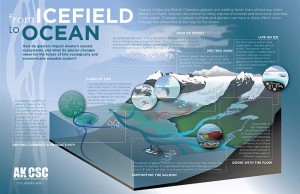
Glacier icefields cover a significant part of Alaska and they effect the state’s resource based economy. Power generation, tourism activities and fish productivity are all influence by the behavior of glaciers. Glacier change from icefield to ocean affects Alaska’s future. Shad O’Neel, a researcher with the U.S. Geological Survey has coauthored a paper that begins […]
Alaskan Fisheries are being threatened f...

Due to increases in the carbon dioxide (CO2) caused by global human development, Alaskan Fisheries are being threatened from ocean acidification. There are at least two highly productive crab fisheries located in state that could be harmed by the uptake of atmospheric CO2 into marine waters. A study published in Progress in Oceanography addresses this […]
High Mercury Levels Found in Alaskan Par...

A study conducted for the National Park Service (NPS) was recently published by the United States Geological Survey (USGS) concerning high mercury levels found in Alaskan national park fishes. High concentrations of mercury negatively affect wildlife survival and reproductive success. Human consumption of fish with elevated levels of mercury contributes to a number of serious […]
Career Training for Ports and Marinas

Successful clean harbor programs depend on the efforts of skilled, well qualified employees to operate moorage basins in an environmentally sensitive manner. The training of employees is expensive, more so in Alaska with its vast travel distances. Coupled with limited training budgets, harbors often lack the ability to encourage the career development of their staff […]
Crowley Tug Sea Voyager Participating in...

Rate and Scale of Arctic Ocean Acidifica...

Researchers have found the rate and scale of Arctic Ocean acidification is unparalleled in recent history. Some 20 percent of the Canadian Basin has become more acidic in a short period of time. Swiftly melting sea ice is being seen as the primary cause of this increase in acidification. Seawater absorbs around 25 percent of […]